
 简体中文
简体中文
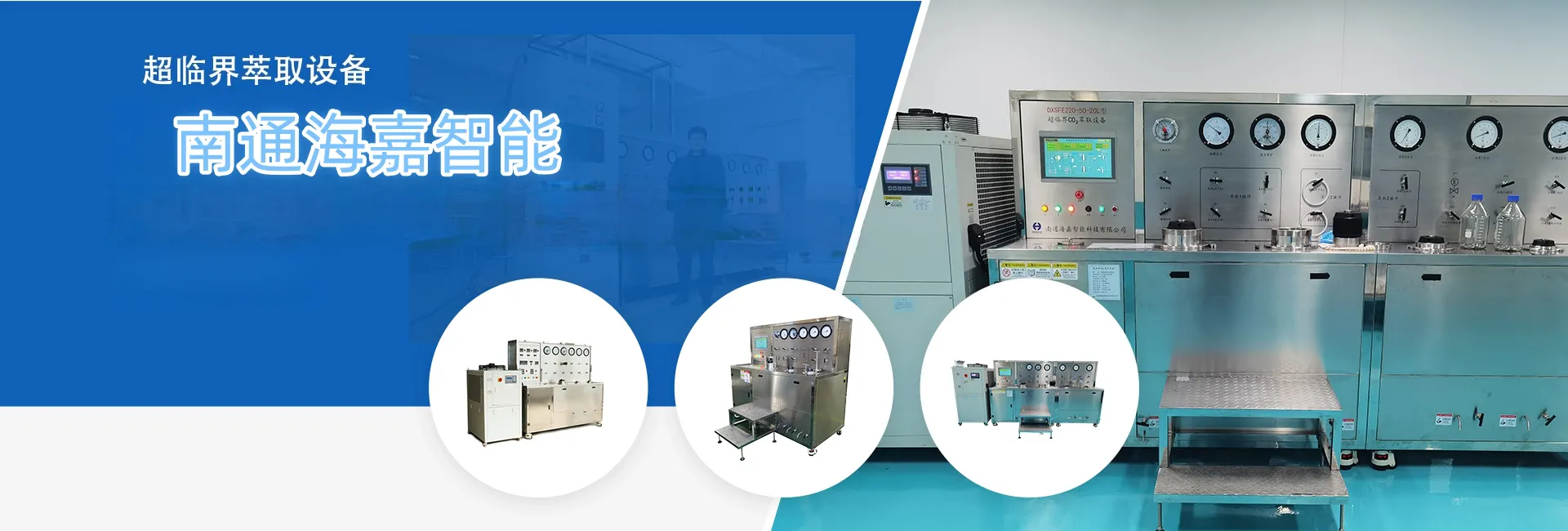
In the industrial production of supercritical extraction, the process can be increased or optimized according to different process requirements (such as target ingredient purity, raw material complexity, production capacity requirements, etc.), which can be realized in the following directions to improve extraction efficiency, product purity and process adaptability:
First, increase the pretreatment process for "complex raw material system"
Direct extraction of complex raw materials (such as plant rhizomes containing fibers, oils, impurities, animal tissues, etc.) can easily lead to blockage of the extraction kettle and low mass transfer efficiency. It is necessary to increase the pretreatment steps:
raw material crushing and sieving through mechanical crushing (such as grinder, colloid mill) to refine the raw material to a suitable particle size (usually 10-50 mesh), increase the specific surface area, and reduce the mass transfer resistance of supercritical fluids (such as CO 2). For raw materials containing a lot of water (such as fresh plants), add low temperature lyophilization or hot air drying process to reduce the moisture content to less than 5% (to avoid the mutual dissolution of water and supercritical CO ² affecting the extraction selectivity). Raw material degreasing/deimpurity pretreatment If the target ingredient coexists with impurities such as oil and wax (such as plant polyphenols, alkaloids), low-polarity solvent preextraction (such as hexane) can be used to remove the oil, and then supercritical extraction can be carried out to reduce the subsequent separation pressure. For raw materials containing viscous components such as colloids and polysaccharides, a small amount of filter aids (such as diatomaceous earth) can be added to reduce the viscosity of the system through filtration pretreatment.
Second, increase the multi-stage extraction/cyclic extraction process for "low extraction efficiency"
When a single extraction cannot fully extract the target components (such as high boiling point, strong polar substances), mass transfer can be enhanced through process optimization:
multi-stage series extraction uses a 2-3 stage extraction kettle in series, the raw materials pass through the extraction kettle at all levels in turn, and the supercritical fluid flows in the opposite direction (countercurrent extraction) to gradually increase the concentration of the target components. For example: the first stage: low pressure/temperature extraction of soluble components; the second stage: high pressure/temperature extraction of insoluble components, reducing the amount of solvent and improving the extraction rate. The circulating extraction process involves reflowing the extracted solvent-rich phase (containing the target ingredient) to the extraction kettle, re-contacting with fresh raw materials, and increasing the concentration of the target ingredient in the fluid through circular enrichment, which is especially suitable for the extraction of low-content components (such as active ingredients in traditional Chinese medicine).
Third, for "low purity of the product" to increase the multi-stage separation/purification process
supercritical extraction products often contain a small amount of co-extraction impurities (such as pigments, volatile oils), the need to increase the separation and purification steps:
multi-stage depressurization separation using different components in the supercritical fluid solubility of the pressure sensitivity difference, set 2-3 stage separation kettle, step by step reduce the pressure (such as from 30MPa to 10MPa and then to 5MPa), so that different impurities in different pressure fractions precipitated, the target component in the final fractions enriched. Example: When extracting vegetable essential oil, the first separation (higher pressure) to retain high boiling point impurities, two separation (lower pressure) to obtain pure essential oil. Adsorption/distillation-assisted refining adds an adsorption column (such as silica gel, activated carbon) after the separation process to adsorb residual impurities; or supercritical distillation is used for volatile components (using the "distillation-like" characteristics of supercritical fluids), and the separation of components is strengthened by trays or fillers to improve the purity to more than 90%.
IV. Increase energy recovery and integration process for "high energy consumption"
The high-pressure pump and heating/cooling system of supercritical extraction have high energy consumption, which can reduce energy consumption through process integration:
fluid circulation and energy recovery After the low-pressure CO (or other solvents) discharged from the separation kettle are recovered by the compressor, heat exchange is carried out with the fresh fluid to be entered into the extraction kettle through the heat exchanger to recover waste heat (can reduce energy consumption by 20% -30%). The frequency conversion high-pressure pump is used to dynamically adjust the flow according to the extraction stage to avoid no-load energy consumption. Coupling with other processes to integrate the products that need to be purified later, the supercritical extraction is connected in series with the membrane separation (such as nanofiltration), crystallization and other processes to reduce the energy consumption of the intermediate link. For example: The solution after supercritical extraction directly enters the membrane module, trapping macromolecular impurities without additional solvent dilution.
Fifth, for "large-scale production" to increase the continuous and automated process
Batch production efficiency is low, parameter fluctuations are large, and stability can be improved through continuous transformation:
continuous feed and discharge system design spiral conveyor extraction kettle, the raw materials are continuously entered into the extraction zone by spiral propulsion, and the supercritical fluid is in continuous contact with countercurrent. With online detection devices (such as near-infrared spectroscopy) to monitor the concentration of the extract in real time, and dynamically adjust the flow rate and pressure. The automation control system integrates a PLC control system to perform closed-loop control of extraction pressure, temperature, fluid flow, and separation kettle parameters, reducing manual intervention and ensuring batch stability (especially suitable for food, medicine, and other fields that require high quality consistency).
Summary
Adding a supercritical extraction process requires combining raw material characteristics, target ingredient properties, and process indicators (efficiency, purity, energy consumption). Through the optimization of the whole chain of "pretreatment-extraction-separation-recovery", the upgrade from "simple extraction" to "efficient refining" is realized. For example, in the extraction of traditional Chinese medicine compounds, a complete process of "raw material crushing, low temperature drying, multi-stage countercurrent extraction, two-stage depressurization separation, adsorption and refining solvent recovery" can be formed, taking into account the extraction rate (95%) and product purity (90%), while reducing unit energy consumption.


