
 简体中文
简体中文
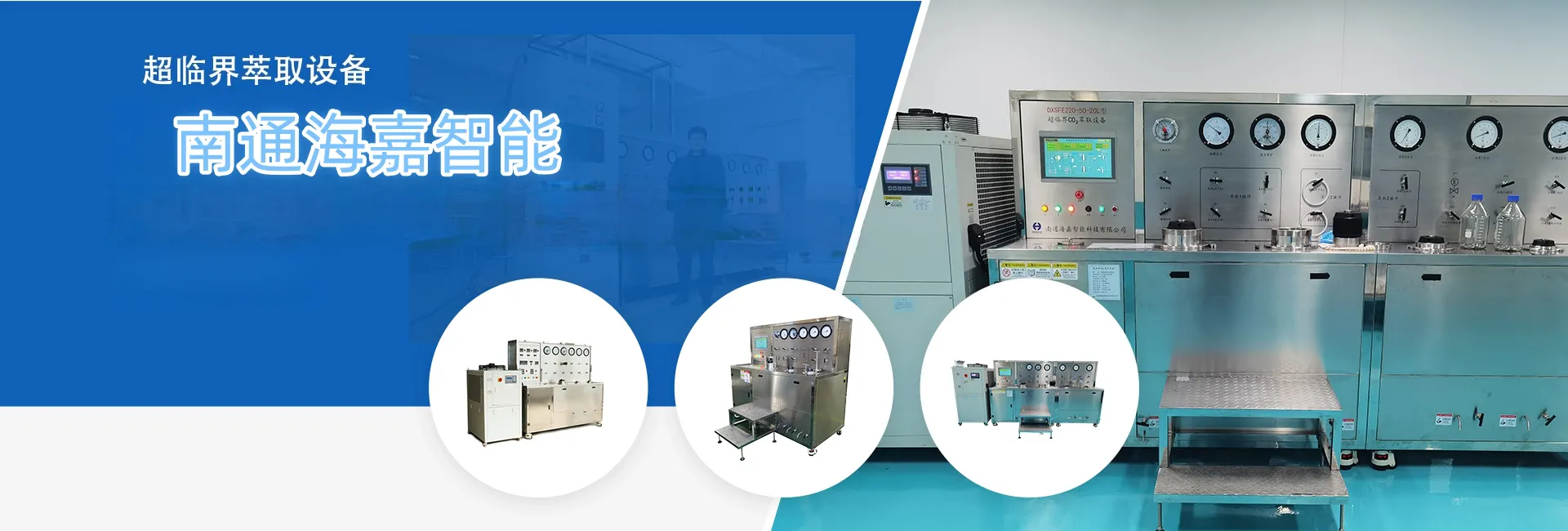
Carbon dioxide supercritical fluid extraction (SC-CO 2 extraction for short) technology is a green process that uses the special physical and chemical properties of carbon dioxide in the supercritical state to achieve material separation. Its core principle can be analyzed from the three aspects of "supercritical state characteristics", "dissolution-separation mechanism" and "process cycle logic": 1. Supercritical state: "special form" of CO2 The substance exists in three phases: gas, liquid and solid. When the temperature and pressure exceed its "critical point", it will enter the supercritical state - at this time the fluid is neither gaseous nor liquid, and has the dual characteristics of gas and liquid:
critical point parameters: The critical point of CO 2 is mild (temperature 31.1 ° C, pressure 7.38MPa), much lower than that of water ( 374 ° C, 22.1MPa) and other solvents, easy to achieve in industry. Core characteristics of supercritical CO2: low viscosity and high diffusivity of similar gases: the diffusion coefficient is 10-100 times that of liquids, which can quickly penetrate into solid substrates (such as plant cells) and improve extraction efficiency; High solubility of similar liquids: the density is close to that of liquids (0.2-0 g/cm ³), which can dissolve a variety of organic compounds (especially fat-soluble components, such as oils, volatile oils, terpenoids, etc.); Solubility adjustability: by slightly changing the temperature or pressure, its density can be significantly changed (and then the solubility) - this is the key to achieving "precise separation". Second, the core mechanism: the dynamic process of dissolution-separation SC-CO 2 The essence of extraction is to use "the selective dissolution of supercritical CO 2 to the target component" and "the sensitivity of dissolution capacity with temperature/pressure" to complete the "extraction-separation" closed loop: 1. Extraction stage: the dissolution of the target component Process: the raw materials (such as plant crushed matter, solid particles) are loaded into the extraction kettle, and the CO 2 is compressed and heated to a supercritical state (above 31.1 ° C, above 7.38 MPa), and then continuously passed into the extraction kettle. Principle: Supercritical CO2 penetrates the raw material matrix with high diffusivity, contacts and dissolves with target components (such as oils, volatile oils) - the solubility depends on the density of CO2 (the higher the density, the stronger the solubility), and the density can be controlled by adjusting the temperature and pressure of the extraction kettle (for example: high density at high pressure and low temperature, suitable for dissolving high boiling point components; low density at low pressure and high temperature, suitable for dissolving low boiling point components). 2. Separation stage: The precipitation of the target component Process: The supercritical CO2 (called "rich fluid") that dissolves the target component enters the separation kettle, breaks the supercritical state by lowering pressure or heating up, and causes the density of CO2 to drop sharply. Principle: The solubility of the target component in CO 2 decreases sharply with the decrease of density, so that it precipitates from CO 2 and remains in the separation kettle; while the CO 2 (called "lean fluid") that loses its solubility is cooled, compressed and recycled back to the extraction kettle to achieve resource repurpose. Selective separation: the root of the core advantage SC-CO 2O extraction can achieve "precise separation", the key lies in the difference in the dissolution characteristics of the target components and impurities in supercritical CO 2:
polarity difference: supercritical CO 2 is a non-polar solvent (similar to hexane), the dissolution ability of fat-soluble components (such as fatty acids, terpenes, steroids) is strong, the dissolution ability of water-soluble components (such as sugars, amino acids) is weak, and the fat-soluble target can be selectively extracted; molecular weight difference: small molecule components (such as volatile oils) are more soluble than macromolecule components (such as waxes), and can be separated by adjusting the pressure (such as priority dissolution of small molecules under low pressure); adjuvant regulation: if the target component is weakly polar (such as flavonoids), a small amount can be added Polar entrainers (such as ethanol) enhance the solubility of CO2 and expand the scope of application. Summary of technical characteristics Green environmental protection: CO2 is non-toxic, non-flammable, chemically inert, no solvent residue after extraction, avoiding pollution of traditional organic solvents (such as petroleum ether); mild and efficient: the extraction temperature is usually 35-60 ℃ (lower than the boiling point of water), suitable for the extraction of heat-sensitive ingredients (such as vitamins, enzymes, essential oils), and retains the activity; strong controllability: by adjusting the temperature, pressure, and entrainer ratio, the extraction efficiency and product purity can be flexibly controlled, and it is easy to industrialize and scale up.
this principle makes it widely used in food (such as caffeine removal, essential oil extraction), medicine (such as purification of active ingredients of traditional Chinese medicine), chemical industry (such as natural pigment extraction) and other fields, becoming an important green technology to replace traditional organic solvent extraction.


